
TL;DR: AdSense doesn’t approve URL shortener sites — and even on regular content sites, AdSense often pays poorly for shortener-adjacent niches (downloads, deals, mirrors). The working AdSense alternatives in 2026 fall into three categories: popunder networks (PopAds, PopCash, Adsterra), monetizing URL shorteners that pay you per click (ShrtFly, AdFly, ShrinkEarn), and direct ad networks for niche traffic (Ezoic, Mediavine for high-traffic content). This post compares all three with real CPM data, minimum-traffic requirements, and which one fits which audience.
I’ve tested every category on different traffic shapes since 2020 — small Tier-3-heavy channels, mid-size mixed traffic, US-heavy niche blogs. The “best” alternative isn’t a single answer. It depends on whether you have an audience that clicks links, whether you have a real content site, and where your traffic comes from. Here’s the honest comparison.
Quick Verdict — Which Alternative Fits Which Publisher?
| Your situation | Best AdSense alternative |
|---|---|
| URL shortener site only (no content blog) | ShrtFly (or any paying shortener) — only viable choice |
| Content blog + you share lots of outbound download / deal links | ShrtFly stacked WITH AdSense on the content site |
| AdSense rejected for niche reasons (gambling, crypto, adult-adjacent) | Adsterra (popunder + display) or PropellerAds |
| 50K+ monthly pageviews on real content | Ezoic (no minimum traffic) or Mediavine (50K+ minimum) |
| Telegram channel admin, no website | ShrtFly — direct shortener earnings without AdSense in the picture |
| Tier-3 traffic only | Adsterra + ShrtFly combo (low-tier-traffic-friendly minimums) |
Category 1 — Monetizing URL Shorteners (Free, You Earn Per Click)
The most direct AdSense alternative for shortener-adjacent traffic. Same interstitial ad mechanic, but the publisher gets the ad revenue.
Top platforms in 2026:
| Platform | Min payout | Top CPM | Operating since | Notes |
|---|---|---|---|---|
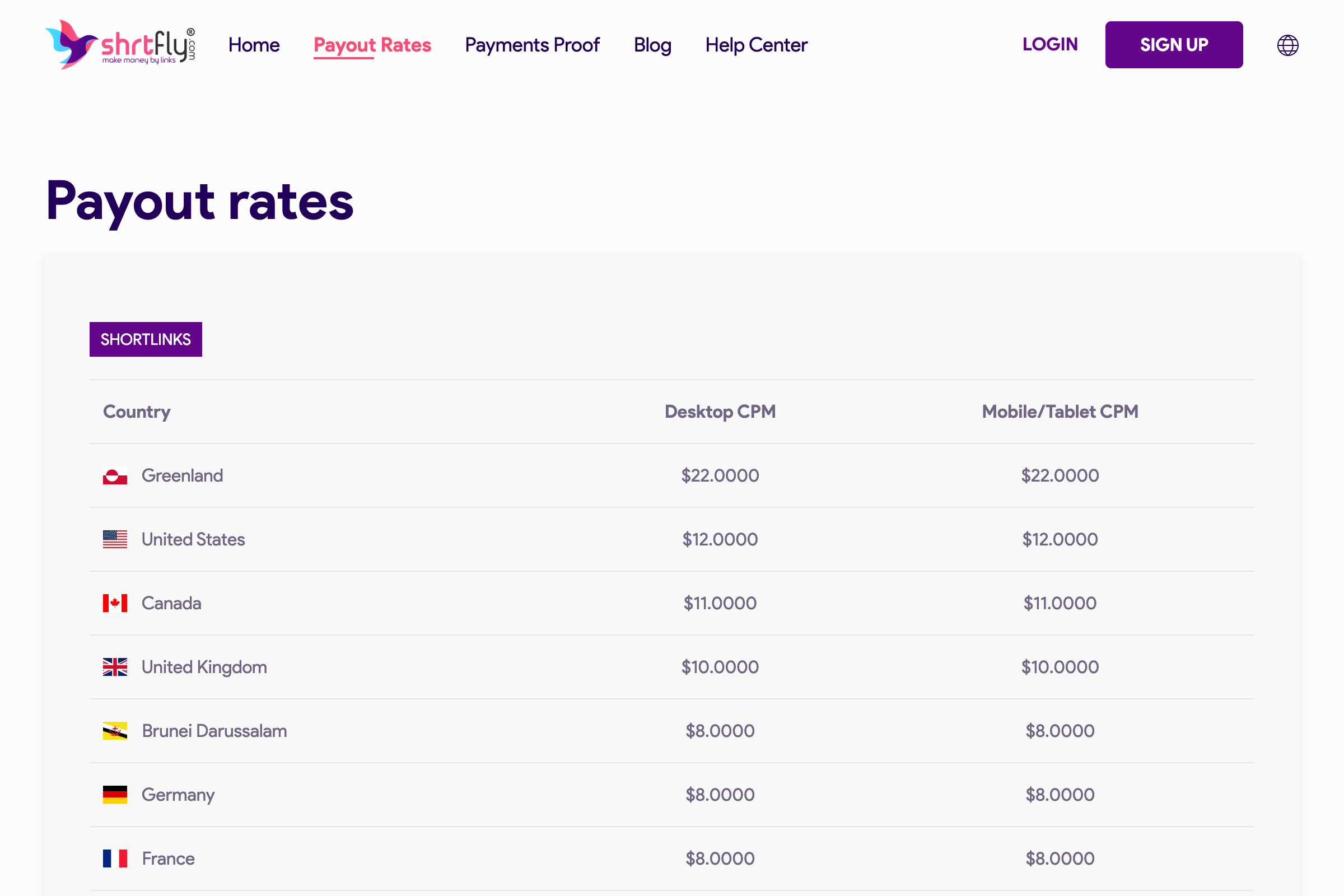
| ShrtFly | $5 | $22 (GL), $12 (US) | 2018 | Daily payouts, public payment proof, 4 withdrawal methods |
| AdFly | $5 | ~$10 (US) | 2008 | Oldest in space, slower payouts, fewer methods |
| ShrinkEarn | $5 | ~$15 (US) | 2017 | Active community, mixed payment reliability |
| Linkvertise | €5 | varies | 2019 | EU-focused, more aggressive ad load |
| Ouo.io | $5 | ~$8 (US) | 2014 | Simple UI, lower CPMs than peers |
When this category wins:
- You have an audience that clicks outbound links (Telegram channels, YouTube descriptions, blog sidebars)
- You don’t have or don’t qualify for AdSense
- You want a per-click revenue model with no minimum traffic
- You’re in a niche AdSense restricts
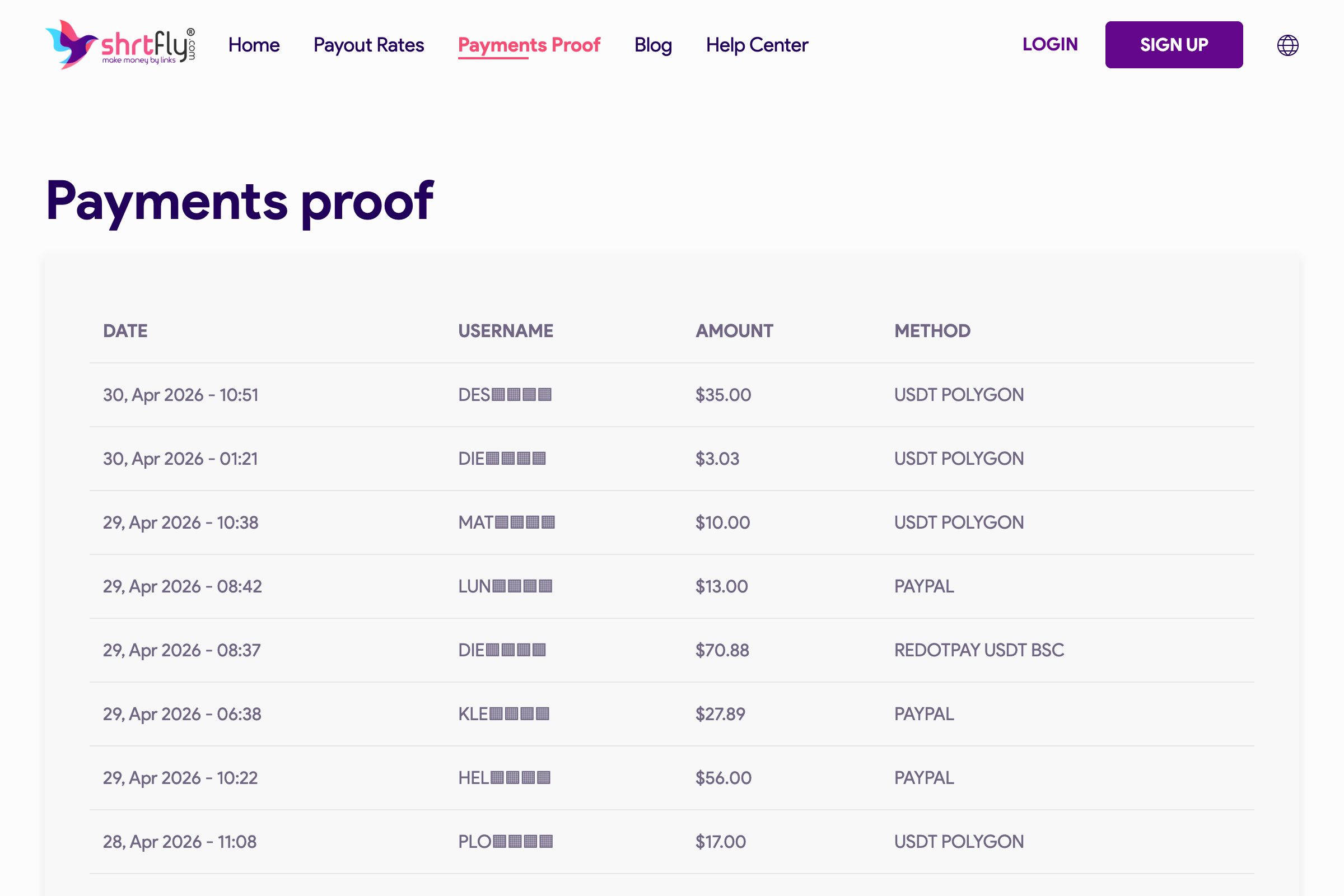
ShrtFly’s public payments-proof page shows the model running in real time:
Category 2 — Popunder Ad Networks (Direct AdSense Substitute)
Popunder networks fill the same display-ad-on-content-site role as AdSense but with looser approval rules. They serve a popunder ad (a new tab/window opening behind the user’s current view) that pays per impression.
Top popunder networks for shortener-adjacent niches:
| Network | Min traffic | CPM range | Approval difficulty |
|---|---|---|---|
| PropellerAds | None | $0.50–$5 (varies wildly by geo) | Easy |
| Adsterra | None | $1–$8 (US/UK) | Easy, accepts most niches |
| PopAds | None | $0.20–$3 | Very easy, lowest CPMs |
| PopCash | None | $0.30–$2.50 | Very easy |
| HillTopAds | None | $0.50–$4 | Easy |
When this category wins:
- You have a content site but AdSense rejected it (niche/traffic concerns)
- You’re OK with popunder ads (they’re more aggressive than display)
- You want unconditional approval
Trade-offs versus AdSense:
- ✅ No approval gate — almost anyone gets accepted
- ✅ Pays via PayPal, Payoneer, Wire (Adsterra/PropellerAds at least)
- ❌ Lower per-impression revenue than AdSense in Tier-1 markets
- ❌ More aggressive ad UX (popunders open new windows/tabs)
- ❌ Some popunder ads ARE the kind of ad your audience hates — you have category control but fine-grained advertiser blocking varies by network
For sites with majority Tier-3 traffic, popunder networks often out-earn AdSense even when AdSense approves them — the floor CPMs are higher in those geos.
Category 3 — Premium Display Networks (For Real Content Sites)
If you have a substantive content site with real traffic, premium display networks pay 2–5x AdSense per pageview but require more polish.
The 2026 hierarchy:
Ezoic — No minimum traffic gate, smart ad placement using machine learning, pays 2–3x typical AdSense RPMs on the same traffic. Fastest path off AdSense for small/mid sites. Approval requires a real content site with original writing.
Mediavine — 50,000 monthly sessions minimum, much stricter quality bar (original long-form content, clean site design, 1+ year of consistent posting). Pays 3–5x AdSense RPMs. The premium tier most content publishers aim for.
Raptive (formerly AdThrive) — 100,000 monthly sessions minimum, even higher quality bar. Top RPMs in the space. Editorial review of every applicant.
When this category wins:
- You have a real content site (not a shortener UI)
- Traffic exceeds the minimum gate
- Content quality clears the editorial review
These networks won’t help a shortener-only or shortener-adjacent site. They will help a real content blog that uses shorteners for outbound references.
The Combined Stack — Realistic 2026 Numbers
For a publisher running multiple alternatives at once, here’s how the stack adds up:
Scenario A: Telegram channel admin, 5,000 subscribers, no website
- AdSense: Not applicable (no site)
- Best fit: ShrtFly only
- Realistic monthly: $80–$300 depending on country mix and posting cadence
Scenario B: Content blog, 30,000 monthly pageviews, US-heavy traffic
- AdSense or Ezoic: $90–$300/month
- ShrtFly stacked on outbound links (~30% click-through to outbound): $108
- Total: $200–$408/month
Scenario C: Niche blog AdSense rejected (e.g. mod APK / cracked software)
- AdSense: $0 (rejected)
- Adsterra popunder: $40–$120 on 30K pageviews
- ShrtFly on download links (high outbound CTR): $200–$600
- Total: $240–$720/month
Scenario D: Real content blog, 100K monthly sessions, qualified for Mediavine
- Mediavine: $400–$1,500
- ShrtFly on outbound: $200–$400
- Total: $600–$1,900/month
The pattern: shortener earnings stack ON TOP of any display ad network. They aren’t a replacement — they’re an additional revenue line that doesn’t compete for the same ad space.
What to AVOID When AdSense Says No
Three categories that look like AdSense alternatives but aren’t:
1. PTP / Paid-To-Click sites. Platforms that pay users to click links. The CPM economics don’t work — a network paying users to click can’t sustainably pay publishers per click too. The math is broken. Anyone running on a PTP network is the user, not the publisher.
2. Crypto-faucet display ads. Sites that pay you in crypto for showing their network’s display ads. Most fail within 18 months because the underlying advertiser demand isn’t real. If a network only pays in their own token, walk away.
3. “Guaranteed CPM” networks promising $20+ flat rates. Real ad CPMs depend on advertiser demand and visitor country — they don’t have a flat rate. Anyone “guaranteeing” a high CPM is selling signups, not running an ad business.
The legit options are all in the three categories above. Anything else is a flag.
Picking Your Alternative in 60 Seconds
Quick decision tree:
- Do you have a content site? No → ShrtFly only. Yes → continue.
- Has AdSense approved you? No → Adsterra/PropellerAds + ShrtFly. Yes → continue.
- Are your monthly pageviews under 10K? Yes → AdSense + ShrtFly stack. No → continue.
- Are your monthly sessions over 50K? Yes → Apply to Mediavine + keep ShrtFly. No → Move to Ezoic + ShrtFly.
Whatever path, ShrtFly slots in at every layer because the per-click model doesn’t compete with display impressions. We covered the stack mechanics in why AdSense doesn’t allow URL shorteners directly and the free vs paid shortener landscape.
FAQ
Is Adsterra better than AdSense in 2026? For Tier-1 traffic on real content sites, AdSense and Ezoic still beat Adsterra on display-ad CPM. For Tier-3 traffic or AdSense-rejected niches, Adsterra often wins. Many publishers run BOTH (AdSense for display, Adsterra popunder as a second layer) where AdSense terms allow.
Can I run ShrtFly alongside AdSense on the same blog? Yes. ShrtFly only shows ads on the SHORTENER’S domain (the redirect page), not on yours. AdSense lives on your blog pages. The two never overlap. We covered this in detail in why AdSense doesn’t allow URL shorteners.
Which AdSense alternative pays the fastest? ShrtFly — $5 minimum, daily withdrawal window, payments via PayPal/Payoneer/Paytm/USDT typically settle in 24–72 hours. Adsterra/PropellerAds: net-30 or net-15 depending on tier. Ezoic: net-30. Mediavine: net-65.
Do I need a website to use AdSense alternatives? Depends. Display networks (AdSense, Ezoic, Mediavine, Adsterra) all require a website. URL shortener earnings (ShrtFly, AdFly) don’t — you can earn purely from social/Telegram/YouTube clicks without a website.
Can I use AdSense alternatives on a YouTube channel? YouTube doesn’t allow third-party display ads on the platform itself. But you can use URL shortener earnings on links in your video descriptions. Many YouTubers route their tutorial / download / affiliate links through ShrtFly for the per-click revenue.
What’s the highest-paying URL shortener in 2026? Per-click pay depends on traffic country, not the shortener’s marketing claims. Greenland traffic pays $22 CPM on ShrtFly, US traffic pays $12. Other shorteners advertise higher numbers but rarely deliver them on real traffic. Test on your own audience for 30 days, then judge.
Is it worth applying to AdSense if I already use a shortener? Yes if you have a real content site. Use the shortener for outbound links inside your articles. AdSense for display revenue on your pages. Stack revenue, no policy conflict, more income per visitor.
Summing Up!
The “AdSense alternative” question is actually three questions: alternatives for shortener-only sites (use a paying shortener), alternatives when AdSense rejects your niche (use Adsterra or PropellerAds), and alternatives that beat AdSense on RPM (use Ezoic for small sites or Mediavine for large ones). All three categories work in 2026; they fit different publisher profiles.
The one constant across every situation: a paying URL shortener like ShrtFly stacks cleanly on top of any of the other choices. It doesn’t compete for display ad space — it earns from outbound links you’d be sharing anyway. For most publishers, the highest-leverage move is adding ShrtFly to whatever they already have running, then optimizing the display layer separately.
Sign up free at ShrtFly, route your next outbound link through it, and run it for 30 days. The first $5 in payouts arrives faster than any display network’s first net-30 cycle.