
TL;DR: Google AdSense bans URL shorteners as a primary content type because the shortened destination page has zero original content — just an ad and a redirect. AdSense’s policy specifically prohibits “thin or duplicated content” and “compelling users to click ads.” If you’re trying to monetize URL shortener traffic, you don’t fight the AdSense rule — you stack a paying URL shortener (like ShrtFly) on top of your existing AdSense site, where the two never collide.
I’ve watched this confusion play out in publisher Telegram groups for years. Someone sets up a shortener-style site, applies for AdSense, gets rejected within a week, and concludes either AdSense is broken or shorteners are illegal. Neither is true. The AdSense ban exists for one specific reason — and once you understand it, the workaround is obvious.
The 30-Second Answer: Why AdSense Says No
Google AdSense rejects URL-shortener-style sites because of three specific policy lines:
| AdSense rule | Why shorteners trip it |
|---|---|
| “Site must offer original, valuable content to users” | A redirect page has no original content — just an ad and a 5-second timer |
| “Sites primarily designed to drive ad impressions” | A shortener literally is that — visitors see one ad, click to leave |
| “No misleading site experience or compelled clicks” | Forcing users through an ad page to reach a destination = compelled |
The AdSense team enforces these rules tightly, especially after the March 2024 Google core update that hit thin-content sites hard. Shortener landing pages fit the textbook definition of thin content, so they get filtered automatically by AdSense’s review system.
This isn’t AdSense being unfair. It’s AdSense protecting advertiser money — advertisers don’t want to pay for impressions on a page where the user is actively trying to skip the ad and get to the destination.
What Actually Triggers an AdSense Ban or Rejection
Three concrete triggers, in order of how often I’ve seen them hit:
1. The site IS the shortener. You set up a domain that serves as a URL shortener (paste long URL, get short URL, share). This domain has no content other than the shortening UI. Result: rejected within 7 days of application.
2. The site has an ad-page interstitial. Your domain redirects through an interstitial ad page on every link click. AdSense reviewers see the redirect chain and flag it as “compelling clicks.” Result: account limited or banned.
3. Heavy use of shortened links inside AdSense content pages. Even on a real content site, if your articles consist almost entirely of “click these short links to download” with no actual written content, AdSense flags it as “thin content.” Result: limited AdSense earnings or full deactivation.
The pattern: AdSense doesn’t care that you’re using a shortener — they care that your site doesn’t deliver content the user came to read.
The Working Stack — How to Use BOTH Without Conflict
The fix isn’t choosing between AdSense and shorteners. It’s running them on different surfaces:
Surface 1 — Your blog (AdSense lives here): A real content site. Long-form articles, original writing, real research, useful information. AdSense ads on the page in standard slots. Fully compliant, fully approved.
Surface 2 — Your shortened links (shortener earns here): Within your real articles, when you link to external resources (download files, deal pages, tutorial mirrors, partner tools), route those links through a paying shortener like ShrtFly. The visitor reading your article hits AdSense ads on YOUR page; when they click an outbound link, they get the shortener’s interstitial ad on the SHORTENER’S domain — completely separate from your AdSense surface.
The two never collide. Two revenue streams stack cleanly.
This is also why ShrtFly explicitly markets as AdSense-compatible — the model is specifically designed to not interfere with your existing display ad inventory.
What Happens to Your Existing AdSense When You Add a Shortener
Three real concerns, all addressable:
Concern 1: Will Google penalize the AdSense account because I use a shortener? No. Google can’t see what you do off-site. Your AdSense account is tied to the SITE running ads. As long as that site stays content-rich and compliant, AdSense doesn’t care what shortener (if any) your outbound links use.
Concern 2: Does the shortener’s ad page count as “associated with” my AdSense site? No. The shortener is on its own domain. Your AdSense policy compliance is judged on YOUR domain. ShrtFly’s ad page is on shrtfly.com — Google evaluates that independently.
Concern 3: Will my visitors get confused by hitting two different ad experiences? This is the only real concern, and it’s behavioral, not policy. Most readers don’t notice — they read your article, click a link, see an ad page, complete the redirect. A pinned “this site uses shortened links to support free content” disclosure on your blog reduces any complaints to nearly zero.
Real Numbers: AdSense vs Shortener Stack Income
For context, here’s how the two streams typically compare on the same blog:
| Monthly traffic to YOUR blog | AdSense earnings | If 30% of pageviews click outbound links → shortener earnings | Combined |
|---|---|---|---|
| 10,000 pageviews | $20–$40 | 3,000 outbound clicks × $0.012 (US-heavy) ≈ $36 | $56–$76 |
| 50,000 pageviews | $100–$250 | 15,000 outbound clicks × $0.011 ≈ $165 | $265–$415 |
| 200,000 pageviews | $500–$1,500 | 60,000 outbound clicks × $0.011 ≈ $660 | $1,160–$2,160 |
Stacking adds 30-100% on top of pure AdSense, depending on how often your content sends readers outbound. The ShrtFly payout-rates page shows the per-country numbers behind the math:
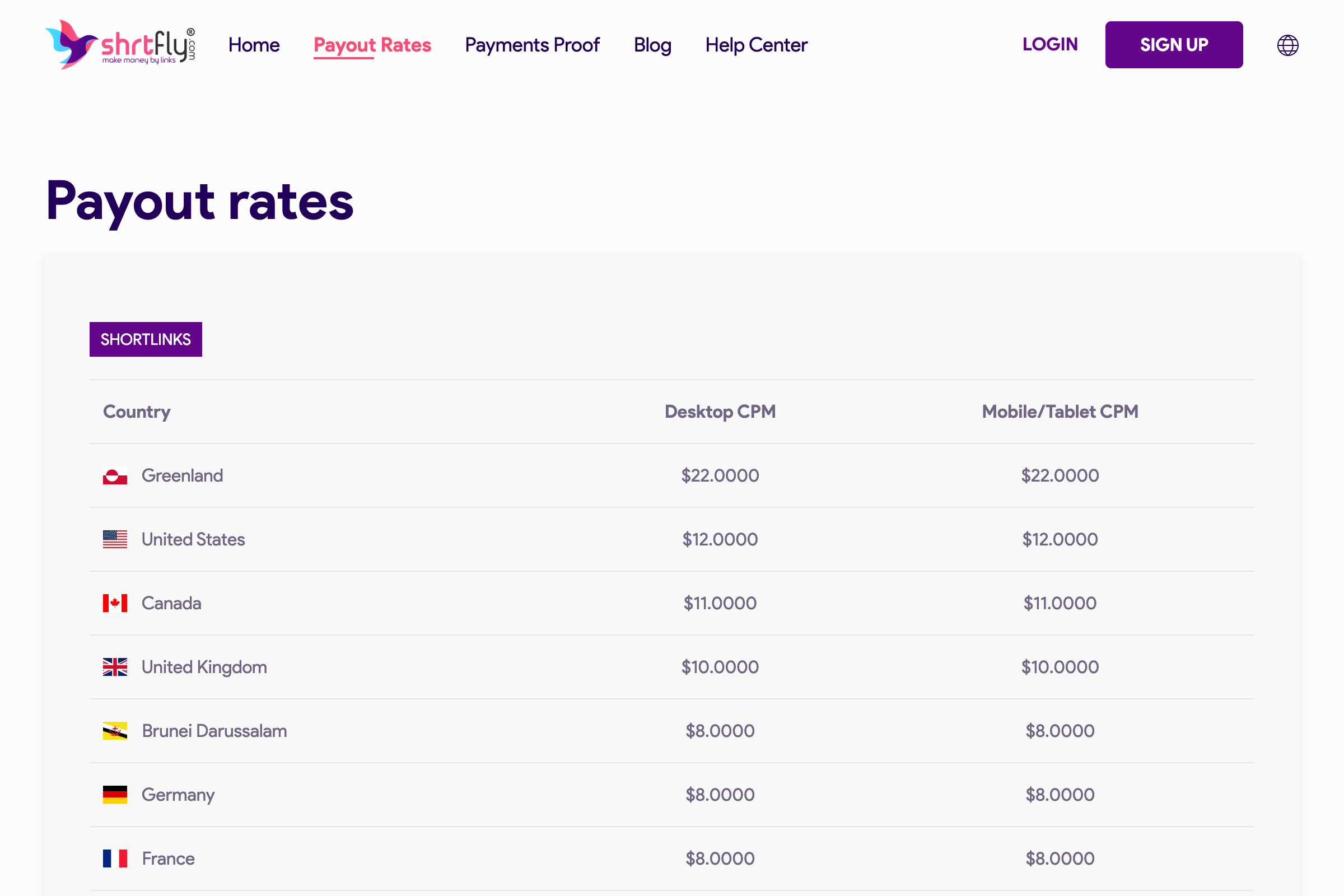
For sites with US-heavy AdSense audiences, the shortener stack often outperforms incremental AdSense optimization (lazy-loading, layout tweaks, additional slots) on a dollar-per-effort basis.
When Skipping AdSense Entirely Makes Sense
Some publishers run a shortener-only stack with no AdSense. This makes sense when:
- Your niche is AdSense-restricted — gambling, certain crypto, adult-adjacent. AdSense rejects the niche entirely; shortener accepts it.
- You’re in a country where AdSense pays poorly — Pakistan, Bangladesh, Vietnam, Indonesia, Nigeria. Shortener CPMs in those regions can match or beat AdSense CPM with much lower minimum thresholds ($5 vs $100).
- Your content doesn’t fit AdSense’s content rules — torrent / mirror / download-aggregation sites get rejected on policy. Shorteners fill the gap.
In those cases, ShrtFly often replaces AdSense as the primary revenue stream. We covered specific use cases in the ShrtFly vs Bitly breakdown and the best AdSense alternatives for shorteners guide.
A 2026-Specific Note on Detection
Google’s AdSense review tooling got noticeably stricter in 2024–2025. The review crawler now:
- Renders your site with JavaScript (catches link cloaking that hides shortener redirects)
- Follows outbound links 1–2 hops deep (catches multi-redirect chains)
- Cross-references your domain against known shortener clusters
What this means in practice: trying to “hide” a shortener-style site as a content site doesn’t work anymore. The reviewer sees the redirect behavior and flags it.
The compliant path is still the stack approach — real content surface for AdSense, separate shortener domain for shortener earnings, no attempt to merge them. We dug into the broader free vs paid shortener landscape for context on the shortener side.
FAQ
Will using ShrtFly inside my blog get my AdSense banned? No. AdSense judges what’s on YOUR site, not what your outbound links do. As long as your blog has real content and isn’t designed primarily to drive shortener traffic, the AdSense account is safe. Most established affiliate / monetization blogs run exactly this stack.
Can I make a URL shortener domain AND have AdSense ads on it? No, not on the same domain. The shortener domain itself can’t host AdSense — it’ll be rejected as thin content. You’d need two separate domains: the shortener (no AdSense) and a content blog about the shortener (AdSense possible if content is original).
What’s the safest way to disclose the shortener stack to readers? A simple footer line or pinned post: “Some outbound links in articles are shortened to support the free content on this site.” Honesty raises trust, reduces complaint rate, and aligns with FTC guidelines for affiliate-style monetization.
Are URL shorteners considered affiliate links by AdSense? No. They’re a separate revenue model. Affiliate links pay you a commission on a product purchase. URL shorteners pay you per ad impression on the redirect page. They can coexist without policy conflict.
Why does AdSense allow ad-supported video platforms (YouTube) but not ad-supported shorteners? YouTube hosts the video content the user actually came to watch. The ad is alongside or before that content. A URL shortener has no destination content — the user’s destination is somewhere else entirely. The first model delivers value to the user; the second is pure friction. AdSense treats them differently because they are different.
Can I appeal an AdSense rejection if I think it was wrong? Yes, AdSense allows appeals via the policy center. The success rate for “thin content / compelling clicks” appeals on shortener-style sites is near zero. The rules are well-established and reviewers apply them consistently. Better path: rebuild the content side and reapply.
Summing Up!
AdSense doesn’t allow URL shorteners as primary sites because shortener pages don’t have the original content AdSense exists to monetize. That’s not changing.
The smart workaround is to run both — a real content blog with AdSense, and shortener links inside that blog’s outbound references for the second revenue stream. The two streams don’t compete, don’t trigger policy violations, and stack additively. Most professional monetization blogs already run exactly this configuration.
If you’ve been hitting AdSense rejections trying to monetize a shortener-only site, switch the model. Build a real content blog in your niche, apply for AdSense on that, and use a paying shortener like ShrtFly for the outbound links inside your articles. First-month AdSense + shortener combined earnings on a small content site usually clear $50–$150. Six months in, the same stack is doing $500–$2,000 a month for the publishers I track. The model works — you just have to build it on the right surface.