
TL;DR: Most “earning site” scams fail one of seven cheap-to-check trust signals — public payment proof, transparent CPM, multiple withdrawal methods, reasonable minimum payout, 2+ years operating history, real customer support, and clean reviews on independent forums. Run any earning site through this 7-point check in 90 seconds before signing up. Sites that pass all seven are reliably legit. Sites that fail three or more deserve a hard pass.
I’ve watched the same three publisher tragedies play out for years: someone earns $40 on a sketchy platform → hits the $50 withdrawal threshold → account “flagged for suspicious activity” → support goes silent → forum complaints multiply → the platform pivots to a new domain six months later. Every single one of those tragedies was avoidable with a 90-second pre-signup check. This is the checklist.
The 7-Point Trust Test (90 Seconds Before You Sign Up)
| # | Trust signal | What pass looks like | What fail looks like |
|---|---|---|---|
| 1 | Public payment proof | Recent dated payouts, varied amounts, multiple methods | “Request via support” or graveyard from 2022 |
| 2 | Transparent CPM | Per-country published rates, clear math | “Up to $50 CPM!” with no breakdown |
| 3 | Multiple withdrawal methods | PayPal + Payoneer + USDT minimum | Internal wallet only, or “store credit” |
| 4 | Reasonable minimum payout | $5–$10 | $50+ or rising thresholds |
| 5 | Operating history | 2+ years live with consistent presence | <12 months, generic "About Us" page |
| 6 | Real customer support | Response within 48 hours pre-signup | Auto-replies, dead email, no live chat |
| 7 | Independent reviews | Mixed but mostly positive on Reddit/Trustpilot | Complaints clustering on “didn’t pay” or “account banned at threshold” |
A site passing all 7 is reliable. A site failing 3+ is almost always a scam. Failing 1–2 doesn’t kill it but lowers confidence — proceed cautiously and start with the minimum payout so your first test withdrawal exposes any issue cheaply.
Trust Signal 1 — Public Payment Proof
The single most important signal. A real earning site has zero reason to hide payouts; they drive signups.
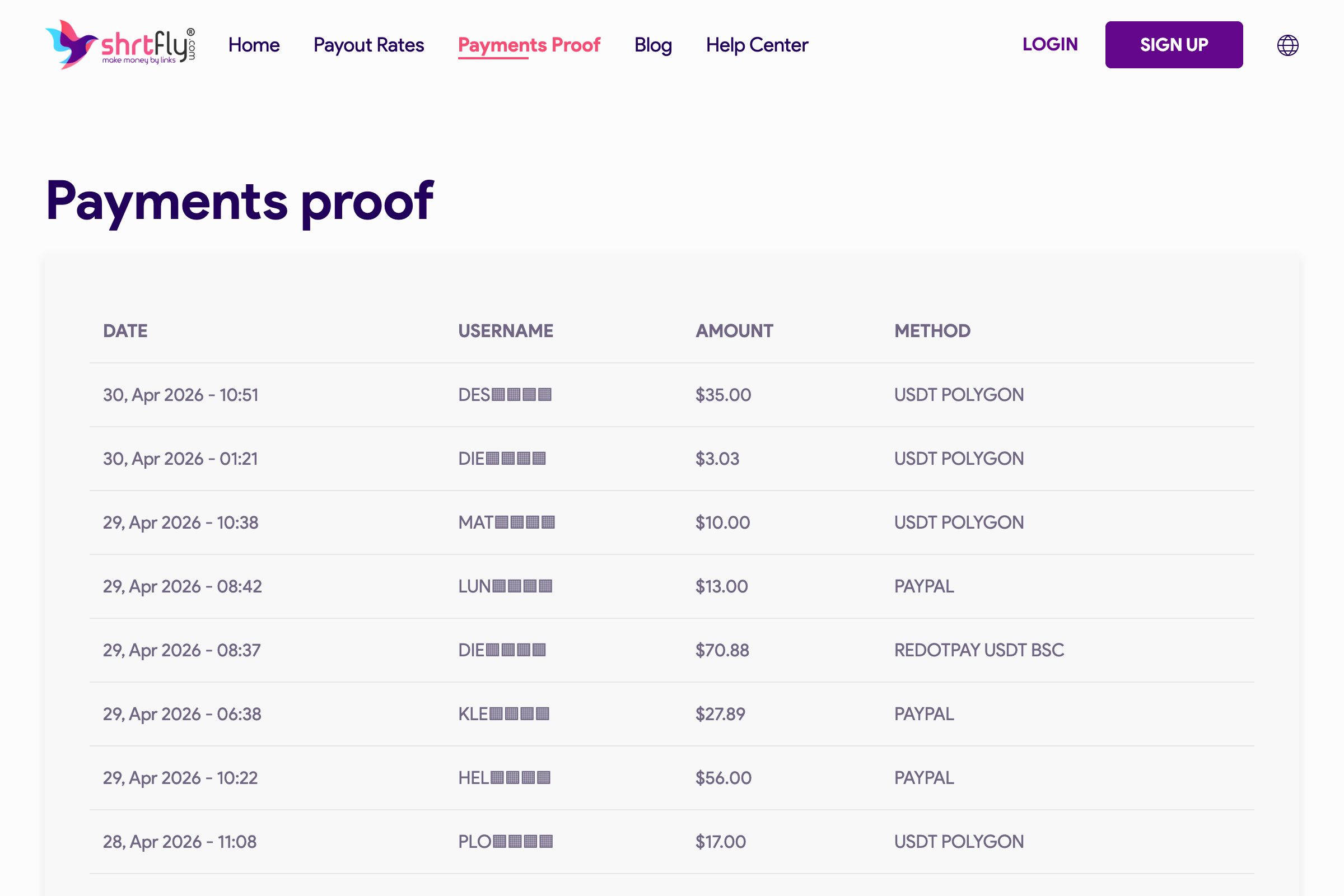
What to verify on a payment-proof page:
- Recency. The most recent payout should be within 7 days. If the latest entry is 2+ months old, the platform isn’t running.
- Amount variation. Real payouts are odd numbers ($3.03, $27.89, $70.88) reflecting actual earnings. All-round-numbers ($10, $20, $50) is a sign of fabricated proof.
- Method variation. Multiple methods showing means real publishers in real regions are withdrawing. Single-method only is suspicious.
- Username variation. Different usernames in the recent list. Same 3 usernames repeating = staged proof.
What this looks like fake: “Payment proof: ‘JohnDoe withdrew $5,000 via Bitcoin’ — May 2024.” Round number, single account, old date, single method. Run.
Trust Signal 2 — Transparent CPM Per Country
Real ad-revenue platforms publish per-country payouts because their economics depend on it. Vague ranges are how scammers hide.
What pass looks like (specific, country-by-country):
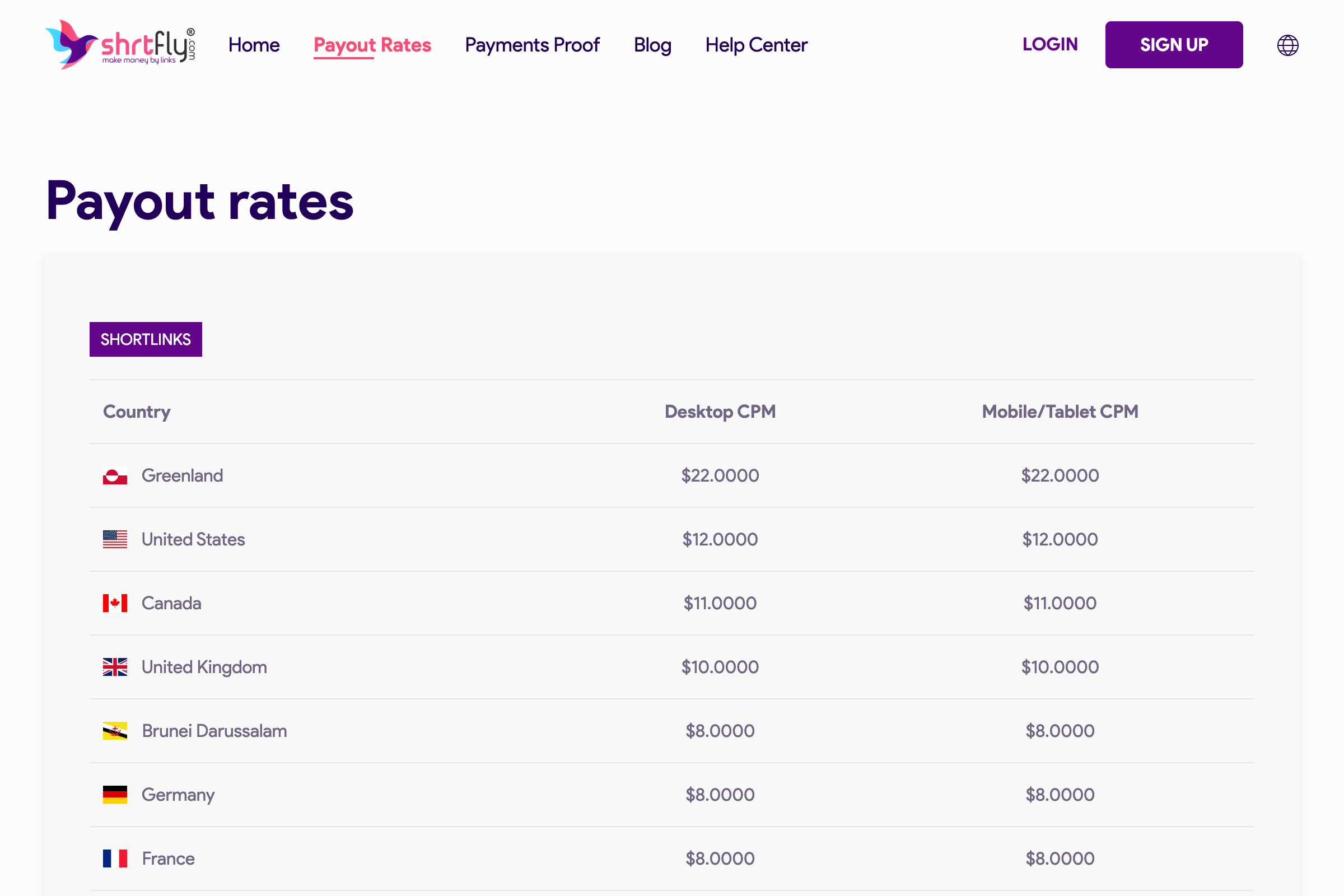
What fail looks like: “Earn up to $50 CPM!” — no per-country breakdown, no math, no realism. Real Tier-1 ad CPMs cap around $20–$25. Anyone claiming $50 across the board is making it up.
A platform that doesn’t publish per-country CPMs has either no actual CPM data (because it doesn’t actually run ads) or knows the numbers are too low to publish. Either way: skip.
Trust Signal 3 — Multiple Withdrawal Methods
This signal exists because of the most common scam pattern — earnings that exist only inside the platform’s “internal wallet” with no real off-ramp.
Pass (multiple real-money methods):
- PayPal
- Payoneer
- USDT (Polygon, BSC, ERC20)
- Bank transfer / wire
- Local rails (Paytm in India, GCash in Philippines, etc.)
Fail (single method or fake methods):
- “Internal wallet” only — meaning your money never leaves the platform
- “Store credit” — meaning you can spend earnings on the platform’s own products only
- “Cryptocurrency we issue” (their own token) — high risk of token going to zero before you off-ramp
- “Bank transfer only, $100 minimum, manual processing” — an excuse to delay or refuse withdrawal
ShrtFly’s payment proof above shows the multi-method signal in action — PayPal, USDT POLYGON, RedotPay USDT BSC all visible in the live feed.
Trust Signal 4 — Reasonable Minimum Payout
The minimum payout exists for one of two reasons:
- Operational ($5–$10): the platform doesn’t want to process tiny micro-payouts. Healthy.
- Stalling ($50–$100+): the platform hopes you’ll quit before reaching threshold. Unhealthy.
Pass:
- $5 minimum (ShrtFly, ShrinkEarn)
- $10 minimum (older shorteners)
- $25 maximum for “high tier” payment methods like wire transfer
Fail:
- $50+ minimum that NEVER drops based on tier
- “Threshold rises by $X for each missed posting day” — a stalling pattern dressed up as anti-spam
- “Withdrawals only at end of month, on a specific date” — unnecessary friction designed to make you forget
A high-minimum platform is betting on dropoff. Real platforms want you to hit threshold so you’ll keep coming back; high-minimum-only platforms profit from the publishers who give up.
Trust Signal 5 — Operating History (2+ Years)
The single best predictor of whether a platform will pay you next month is whether they paid people two years ago.
How to check:
- Check the domain’s WHOIS registration date (
whois domain.com). Less than 12 months old + earning-site claims = almost always a scam. - Search the platform name on Reddit, Trustpilot, BlackHatWorld, Wayback Machine. Established platforms have a track record. Brand new platforms with no presence don’t.
- Check if the company name registered in their footer / About page is searchable. Scams usually use shell company names that don’t return results.
Pass (2+ years):
- ShrtFly (since 2018)
- AdFly (since 2008)
- ShrinkEarn (since 2017)
- Cuttly (since 2017)
- Bitly (since 2008)
Fail (under 12 months):
- Brand new domain registered last week
- “Beta launch” platform — beta means they don’t owe you payment yet
- Platforms claiming “we’re new but our team has 10 years of experience” without proof
Trust Signal 6 — Real Customer Support
The cheapest pre-signup test: email support@theirsite.com with a real question and see what comes back.
Pass:
- Human reply within 24–48 hours
- Reply addresses your specific question (not a copy-paste FAQ)
- Multiple support channels visible (email, ticket, sometimes live chat)
- Public help center / knowledge base with real articles
Fail:
- Email bounces or auto-reply only
- 7+ days with no response
- Reply text is identical to multiple Reddit complaints (suggesting a canned scam template)
- No support email visible anywhere on the site
This single test catches more scams than any other check. Sites that won’t talk to you before you give them traffic certainly won’t talk to you when you’re owed money.
Trust Signal 7 — Independent Reviews on Real Forums
Don’t rely on the platform’s own testimonials — they can be fabricated. Look at independent sources where the platform can’t moderate.
Where to look:
- Reddit (r/beermoney, r/passive_income, r/MakeMoney) — long-running threads with actual publishers
- Trustpilot — star ratings and dispute responses
- BlackHatWorld — brutal honesty about earning platforms
- Telegram groups for your country / language — local-language complaints often surface fastest
- The platform name + “didn’t pay me” or “scam” on Google
Pass:
- Mixed reviews skewing positive
- Complaints exist but are addressed (the platform responds publicly to issues)
- 70%+ positive sentiment over 12+ months
Fail:
- Cluster of complaints around the same scam pattern (account ban at threshold, support ghosting, payment delays)
- Mostly 5-star or mostly 1-star with no middle (faked reviews from one direction or the other)
- Recent uptick in negative reviews suggesting the platform is winding down
Quick Trust Check Walkthrough — A Real Example
Let’s run ShrtFly through the 7-point check as a worked example:
| # | Signal | ShrtFly result |
|---|---|---|
| 1 | Public payment proof | ✓ Live page, daily updates |
| 2 | Transparent CPM | ✓ Per-country published rates |
| 3 | Multiple withdrawal methods | ✓ PayPal + Payoneer + Paytm + USDT |
| 4 | Reasonable minimum payout | ✓ $5 minimum, daily withdrawal window |
| 5 | Operating history | ✓ 2018, 7+ years live |
| 6 | Real customer support | ✓ Email + ticket system, sub-24h response |
| 7 | Independent reviews | ✓ Mixed but mostly positive on Reddit / forums |
Score: 7/7. This is what a passing platform looks like.
For comparison, run a random “earn $20/day no traffic needed!” link from your spam folder through the same 7 points. You’ll typically see 0/7 or 1/7. That’s the difference, and it shows up in 90 seconds.
Specific Scam Patterns to Recognize
Beyond the 7-point check, these patterns are diagnostic of scam earning sites:
1. Referral-only withdrawal. “Withdraw $X after referring 5 friends.” Real earning platforms let you withdraw your own earnings without referrals. Anyone gating your money behind referrals is running a pyramid, not an ad business.
2. Threshold rises with each missed day. “Minimum starts at $5; rises by $1 for each day without a deposit.” Designed to make withdrawal mathematically impossible while looking like an “anti-bot” measure.
3. Currency conversion fees on withdrawal that exceed the withdrawal amount. “Convert internal currency to USD costs 80% of balance.” Math designed so you never actually receive money.
4. “Tax payment required before withdrawal.” Real platforms don’t make YOU prepay taxes. They issue a 1099 / tax form, and you settle with your tax authority directly. Anyone asking you to prepay tax is an advance-fee scam.
5. Account suspended at threshold for “violating terms” with no specifics. Vague suspension reasons, no appeal process, support ghosts. Classic “exit scam” pattern when the platform decides to stop paying.
6. New domain + bold income claims + no founder name. A brand-new domain with public marketing claiming $1000s/month earnings without identifiable founders or business registration = always a scam.
What to Do If You’re Already On a Scam Platform
Three steps:
1. Withdraw whatever you can RIGHT NOW. Even if it’s $3 below your normal threshold, withdraw any minimum payout the platform allows. Cut losses early.
2. Stop sending traffic. Every click you send to a scam platform is essentially free traffic for them. Reroute through a verified platform immediately.
3. Document everything for forum reports. Screenshots of dashboard, withdrawal request, response (or lack of). Post in r/beermoney or BlackHatWorld so other publishers can avoid the same trap.
Don’t waste time trying to recover lost earnings from a confirmed scam. Consider the lost amount tuition for the trust check. Move on.
FAQ
How long does running the 7-point check actually take? About 90 seconds for an experienced eye. Maybe 5 minutes if you’re new to the checklist. The Reddit / forum search is the slowest step. The other 6 signals are all visible from the platform’s own site.
What if a platform passes 6/7 — should I trust it? Depends which one fails. Failure on signals 1–4 (proof, CPM, methods, minimum) is structural — usually a hard skip. Failure on 5 (operating history, e.g. a new platform) means proceed cautiously and stick to small test amounts. Failure on 6 (slow support) is recoverable. Failure on 7 (mixed reviews) is contextual — read the complaints to judge severity.
Should I trust a platform with no payment proof page if their parent company is well-known? Maybe. But ask yourself: why does the well-known parent let this product run without proof? Real companies under reputational scrutiny publish proofs to avoid being lumped in with scams. The absence of proof, even from a “trusted” parent, is still a yellow flag.
Are there any earning sites I should always recommend over others? The seven-point check is the recommendation. Any platform passing 7/7 is acceptable. ShrtFly is the one we run, so it’s what we know best, but the framework is platform-agnostic — apply the same checks to any platform you’re considering. We covered the broader URL shortener earning landscape for context.
How do I check operating history fast? Three quick checks: WHOIS lookup for domain registration date, Wayback Machine for archived versions of the site over time, and a Google search for the platform’s brand name limited to results from 2+ years ago (platform-name 2022). Fast and reliable.
Is the 7-point check enough, or are there more checks for high-stakes amounts? For amounts under $500/month, the 7-point check is enough. For amounts above (e.g. you’re considering a platform that would be your primary income), add: company business registration verification, public team members visible on LinkedIn, regulatory compliance (especially if they handle crypto), and a 60-day “test deposit and withdrawal” cycle before scaling traffic.
Summing Up!
Earning-site scams are loud and obvious if you know the signals. The 7-point check — public payment proof, transparent CPM, multiple withdrawal methods, reasonable minimum payout, operating history, real support, independent reviews — separates working platforms from pretenders in 90 seconds.
If a platform passes all seven, run a small test ($5–$10 in earnings then withdraw) before scaling traffic to it. If it fails three or more, walk away regardless of how good the marketing copy looks. The platforms that prosecute every part of the checklist (like ShrtFly) are the ones still operating in five years; the platforms that fail the basics disappear within twelve months and take publisher earnings with them.
Trust isn’t a feeling. It’s a checklist. Run it before you sign up, run it again before you scale, and trust the results over the marketing.