TL;DR: I’m the founder of ShrtFly. The ShrtFly WordPress plugin automatically converts every outbound link on your WordPress site into a monetized ShrtFly short link — no manual shortening, no copy-paste, no missed links. It’s ~3 KB, doesn’t affect page-load speed, and runs entirely on the front-end render. Setup takes 5 minutes: download → upload → activate → paste your API token → optionally exclude domains you don’t want shortened. Full walkthrough with screenshots below.
I built ShrtFly in 2017. One pattern I kept seeing from WordPress publishers: they’d sign up, shorten a few links manually, and then over the following weeks just stop because copying every outbound URL through the dashboard is genuinely tedious. So we built the official ShrtFly WordPress plugin specifically to remove that friction — install once, set your API token, and every outbound link on your site gets automatically monetized from then on. No manual work per post.
The plugin is free, hosted directly on our server (not WordPress.org — more on why below), and the file size is around 3 KB so it has zero meaningful impact on your site’s load speed. Below is the full setup walkthrough as it works in 2026.

Why the Plugin Exists (Founder Note)
Most ShrtFly publishers fall into two patterns. The first group shortens links manually one at a time through the dashboard or browser extension — fine for Telegram channels, social posts, or one-off sharing. The second group runs a blog or content site with dozens of outbound links per post, and for them manual shortening is unrealistic. The plugin solves the second group’s problem.
Three specific things it does well:
- Automatic outbound link conversion — every
<a href="...">pointing off-site gets rewritten on render to your ShrtFly short link. New posts, old posts, archives, all of them, retroactively. - Domain exclusion list — if you don’t want a specific domain (your own properties, your Facebook page, your YouTube channel, affiliate networks that block redirects) shortened, you add it to the exclusion list and the plugin skips it.
- Front-end only render — the plugin rewrites links at page render, not at the database level. Your post content stays untouched. If you ever deactivate the plugin, your original outbound URLs come back instantly.
One honest caveat: the plugin is not on WordPress.org’s plugin directory. That’s because WordPress.org rejects plugins whose primary function is “external monetization with API calls to a third-party service” under their guidelines. So we host the download on our own server. If you’ve read warnings about installing plugins from outside the official directory, that concern is legitimate in general — but the ShrtFly plugin is open source on the inside (you can read every line of PHP after unzipping it), hosted on our verified domain, and digitally signed. Always download it from our official URL and not from any third-party mirror.
Step 1: Download the ShrtFly WordPress Plugin
The plugin downloads as a single .zip file directly from our server. Use this exact URL — please don’t download it from anywhere else, because third-party mirrors of WordPress plugins are a common malware vector:
👉 Download ShrtFly WordPress Plugin (latest version)
The file is around 3 KB and downloads in a second on any connection. Save it somewhere you’ll find it again — you’ll upload it to WordPress in the next step.
Step 2: Upload the Plugin to Your WordPress Site
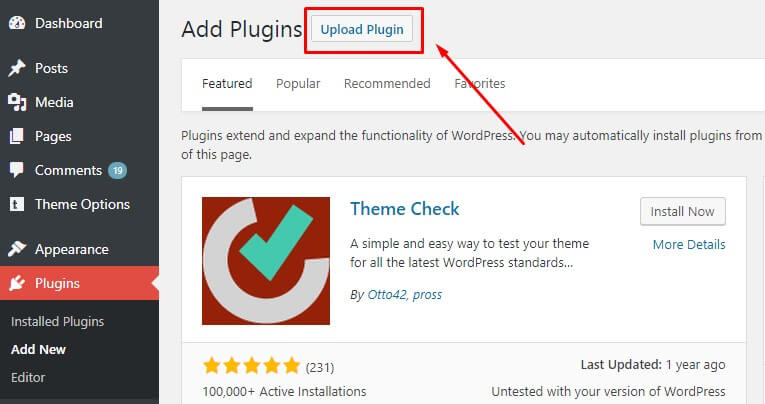
Log in to your WordPress admin dashboard. From the left sidebar, go to Plugins → Add New. At the top of the page, click the Upload Plugin button.
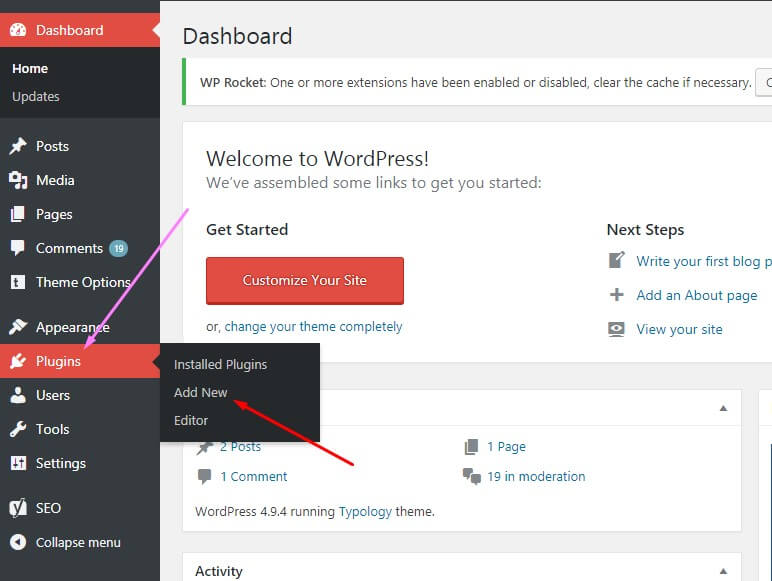
Click Choose File, navigate to the shrtfly-plugin.zip you downloaded in Step 1, select it, and click Install Now. WordPress will upload the .zip, extract it, and install the plugin — the entire operation takes about two seconds because the plugin is tiny.
Step 3: Activate the Plugin
After WordPress finishes installing, you’ll see a confirmation screen with an Activate Plugin button. Click it.
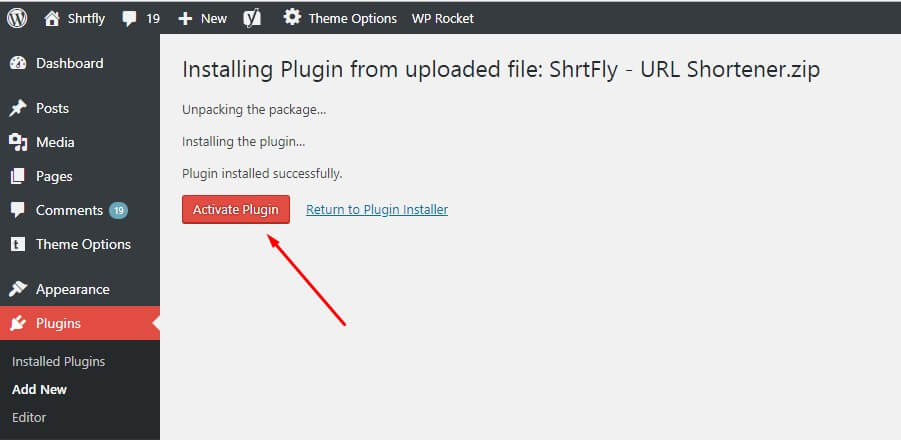
The plugin is now installed and active. It hasn’t started shortening links yet, though — it needs your API token first. That’s Step 4.
Step 4: Open the ShrtFly Settings Page in WordPress
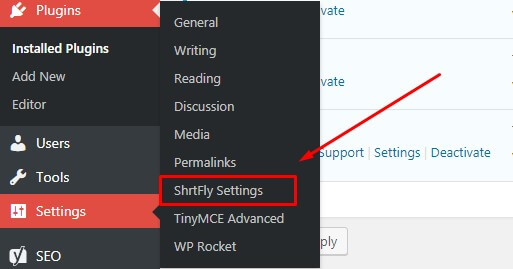
From your WordPress sidebar, go to Settings → ShrtFly Settings. You’ll see a configuration page with three fields:
- Token Key — required, gets your API key from your ShrtFly account
- Domain — important, the exclusion list (which links the plugin should leave alone)
- Patterns — optional, only relevant for advanced users with custom rewrite rules
The next two sub-steps cover Token Key and Domain. Patterns we’ll skip — if you’re advanced enough to need it, the field’s own description is enough.
Step 4a: Get and Paste Your Token Key
Your Token Key is the unique API key that connects this WordPress install to your ShrtFly publisher account. Without it, the plugin doesn’t know whose account to credit the link earnings to.
To get yours: log in to your ShrtFly account, then open the Quick Tools page. Your Token Key is shown at the top of that page. Copy it.
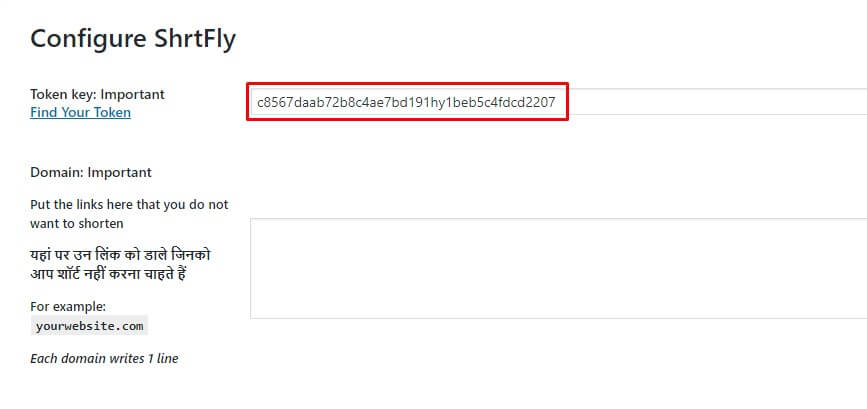
Paste the token into the Token Key field in your WordPress ShrtFly Settings page. Don’t share this token with anyone — it identifies your account and anyone with it can attribute clicks (and the resulting payouts) to themselves through the API.
Step 4b: Set the Domain Exclusion List
This is the most important setting to get right. The Domain field is your exclusion list — every domain you put here will NOT be shortened by the plugin. Anything not on this list will be auto-shortened.
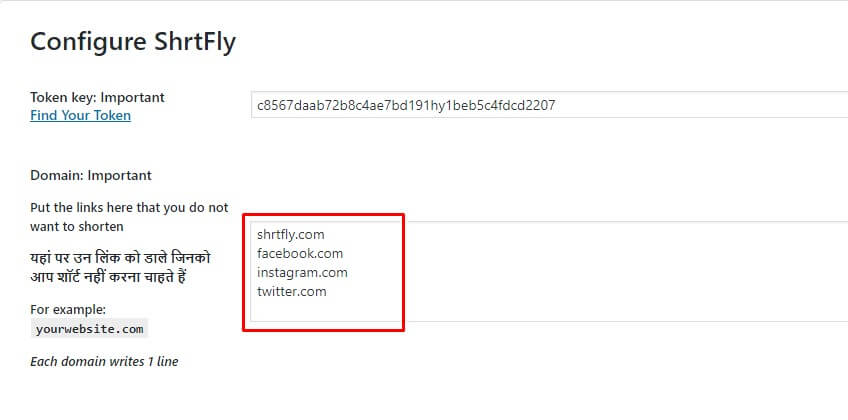
The domains you should almost always exclude:
- Your own website domain — internal links between your own posts should never be shortened. They’re internal SEO weight and shouldn’t pass through a redirect.
- Your social media properties — your Facebook page, Instagram profile, YouTube channel, Twitter/X handle. Visitors expect these links to go directly to those profiles, not through a shortener.
- Affiliate networks that block redirects — Amazon Associates, ShareASale, ClickBank, and several other affiliate programs flag clicks that pass through a third-party redirect. Check each affiliate program’s terms; if they prohibit redirects, exclude the domain.
- shrtfly.com itself — preventing infinite loops if you ever link to ShrtFly in a post.
Add one domain per line in the field. Format example:
yourwebsite.com
facebook.com
youtube.com
amazon.com
amzn.to
shrtfly.com
If you leave the Domain field empty, the plugin shortens every outbound link including the ones above. That’s almost never what you want, so fill this field even before you save.
Click Save Settings at the bottom of the page. The plugin is now live on your site.
Step 5: Verify the Plugin Is Working
Open any page or post on your live site that has at least one outbound link. Right-click the outbound link and inspect it (or hover and look at the status bar). The href should now show a shrtfly.com/ short URL rather than the original destination.
Two specific things to check:
- Internal links still point to your own domain (if you excluded your own domain in Step 4b)
- Outbound links are now ShrtFly URLs that redirect through our ad page to the original destination
If you log in to your ShrtFly account and check the Dashboard, every click on those auto-generated short links will now appear in your analytics in real time. Earnings start accruing from the first click. When you hit the $3 minimum (USDT Polygon), request a payout — the payout request guide covers the withdrawal flow.
Want a Browser Extension Instead? It Exists Too.
If you don’t run WordPress, or if you share links primarily from a browser (Telegram channels, X/Twitter, manual link sharing), the official ShrtFly browser extension is the tool you want. It works on Chrome, Firefox, and Edge (the Edge build also covers Brave, Opera, and other Chromium-based browsers), and lets you shorten any URL with one click from the toolbar without leaving the page you’re on.
The WordPress plugin (auto-shortens links on your site) and the browser extension (shortens any URL you’re looking at, on demand) are complementary — most active publishers end up using both. A dedicated walkthrough for the browser extension is coming as a separate post on this blog soon.
Common Issues and How to Fix Them
“Links aren’t being shortened on my site”
Three likely causes, check in this order:
- Token Key is blank or wrong — copy it again from the Quick Tools page, make sure there are no extra spaces, save
- The links you’re checking are pointing to a domain on your exclusion list — that’s working as intended
- Your site is heavily cached (page caching plugin, CDN like Cloudflare) — clear the cache after activating the plugin, otherwise visitors get the pre-plugin cached HTML
“Affiliate program flagged my clicks for going through a redirect”
Add the affiliate program’s domains to your exclusion list (Step 4b). Save. Clear your site cache. The affiliate links will now point directly to the original URL without going through ShrtFly. This is a per-affiliate-program decision — some programs allow redirects, others don’t.
“Plugin works on new posts but not on old posts”
It should work on both, because the plugin rewrites links at render time, not at save time. If old posts are still showing original URLs, the most likely cause is page caching — old post HTML was cached before the plugin was active. Clear all caches (site + CDN) and the old posts will start showing short links on the next view.
“The plugin is conflicting with another plugin”
Rare but possible. The most common conflicts are with other link-rewriting plugins (Pretty Links, ThirstyAffiliates, Affiliate Link Manager). Run one rewriter at a time. If you’re using one of those for affiliate cloaking, add the cloaked URL domains (your own domain’s /recommends/ path or similar) to the ShrtFly exclusion list so it doesn’t try to re-shorten an already-cloaked URL.
FAQ
Where do I download the ShrtFly WordPress plugin?
Only from our official URL: shrtfly.com/uploads/shrtfly-plugin.zip. We don’t distribute it on WordPress.org, and third-party plugin sites occasionally host outdated or modified versions. Always grab the latest from us directly.
Is the ShrtFly WordPress plugin free?
Yes, fully free. You pay nothing for the plugin and we share the link earnings with you the same as any other ShrtFly publisher. There’s no premium tier or upsell.
Will the plugin slow down my WordPress site?
No meaningful impact. The plugin is around 3 KB and runs a single link-rewrite pass on the rendered page. We’ve benchmarked it on sites pushing 100K+ daily visits and the added latency is in the microsecond range — orders of magnitude below what page caching, image optimization, and other typical perf factors contribute.
Does the plugin work with caching plugins like WP Rocket or W3 Total Cache?
Yes. After activating ShrtFly, do a full cache purge (your caching plugin’s settings will have a “Clear all caches” button). After that, the plugin and your cache play nicely together — the rewritten short links get cached and served fast.
Can I use the plugin alongside AdSense?
Yes. ShrtFly is AdSense-safe — the outbound shortener doesn’t conflict with display ads on your content pages. They monetize different surfaces. The broader topic is covered in why Google AdSense doesn’t allow URL shorteners (and the 2026 fix).
What if I want to exclude specific posts or pages from shortening?
The plugin exclusion is domain-level, not post-level. If you need post-level control — say, leave the entire affiliate-review section of your site unshortened — the cleanest approach is to move affiliate links to a subdomain (links.yourblog.com) and exclude that subdomain. We’re considering post-level controls for a future plugin version.
Download the ShrtFly WordPress Plugin
One reminder: always download from the official URL above. If you ever see the plugin hosted on a third-party site, treat it as suspicious — we publish updates through this one URL only, and we’ll announce major plugin updates on our blog and our Telegram channel.
Summing Up!
The ShrtFly WordPress plugin is the simplest way to turn every outbound link on your site into a monetized short link without any manual work per post. Install it once, paste your API token, exclude the domains you don’t want shortened, save, and you’re done. Every click on every auto-generated short link goes into your ShrtFly dashboard and starts accruing earnings.
If you haven’t set up your ShrtFly account yet, start with the getting-started guide first. If you’re earning and ready to cash out, the payout request guide walks through withdrawals (with the $3 minimum). And for the broader “how to monetize a content site” angle, the best URL shorteners comparison gives the honest founder-view landscape of where ShrtFly fits in the market.
Plugin questions or installation issues, drop them in the comments below or email support@shrtfly.com. We answer everything.